
Today, while speaking on a panel at the RISE Educator Conference, I was asked a question that genuinely stayed with me: “How can we make parents stop their children using their phones?” I found it heart-wrenching, because I can completely understand the frustration behind it. Schools see the consequences of excessive phone use every day. We see students arriving tired because they were messaging, gaming or scrolling late into the night. We see arguments that began in group chats spill into classrooms. We see fractured attention, anxiety about being constantly available, and young people who find it increasingly difficult to disconnect.
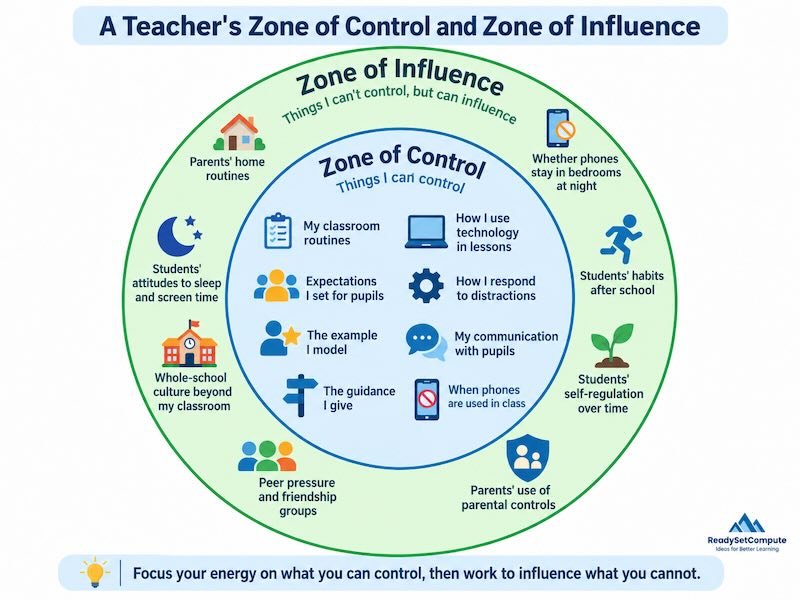
I began by empathizing that this is indeed a tough challenge and that unfortunately I am not going to be able to give them the perfect answer, because students’ use of phones is not something we can directly control. It is however within our sphere of influence. Covey describes a Circle of Concern containing the things we care about and a Circle of Influence containing those things where we can actually have an effect. When working with schools, I find it useful to make that distinction even more practical by thinking about a Zone of Control and a Zone of Influence (Covey, 1989).
Our Zone of Control contains the things we can directly decide or change. Our Zone of Influence contains things we cannot directly control, but where our actions may still make a difference. This sounds simple, but it is an extraordinarily useful distinction in education because we spend a great deal of emotional energy worrying about things that matter enormously to us but which do not actually belong within our control.
A child’s phone use at home is a perfect example. Schools cannot decide where a family charges its phones. We cannot determine whether a parent removes a device at bedtime. We cannot control whether a child spends two hours on TikTok, YouTube, Discord, Instagram or an online game after school. We cannot walk into a family home at 11.30 pm and take the phone away. No matter how strongly we feel about those decisions, they do not belong to the school.
What we can do is point out that the billionaires who make social networks have the strongest controls over their own children (Clarín 2026), model good practice with our own children, and share how parental controls work (see Apple’s page here). While it can be incredibly frustrating when the consequences arrive through the school gates the following morning, spending more energy wishing that we could control something does not give us any greater control over it; Covey’s point about being proactive is not that we should stop caring, but that we should direct our effort towards the places where our actions can actually make a difference.
What schools can control
Schools have a substantial Zone of Control. We can decide what happens on our site. We can establish clear expectations about when phones can and cannot be used. We can create classrooms where technology is used deliberately rather than automatically. We can decide whether every activity needs a screen. We can think about how many platforms we expect students to monitor, how many notifications our systems generate and whether we are inadvertently contributing to the always-connected culture we are trying to address.
We can also control our own behaviour. There is little value in telling students that they must learn to disconnect if adults are constantly checking their own phones in front of them. Similarly, there is a contradiction in encouraging healthy digital boundaries while schools send non-urgent notifications and messages late into the evening. Before asking parents to change what happens in their homes, schools should be willing to examine the digital environment that we ourselves create.
There is another important part of our Zone of Control: safeguarding. If something disclosed through a phone, social media account, group chat or online game suggests abuse, exploitation, grooming, serious bullying or another significant threat to a child’s welfare, this is no longer simply a debate about screen time. Schools have safeguarding responsibilities and should follow the relevant procedures for their jurisdiction. The fact that an incident happened online or outside school does not necessarily make the safeguarding concern disappear.
What schools can influence
Then there is the much larger Zone of Influence. This is where I think schools sometimes underestimate their power. We cannot determine what happens in someone’s home, but we can influence it through education, communication, relationships and culture.
We can explain to families why sleep matters and why having a phone beside a child’s bed can make healthy routines more difficult. We can help parents understand the platforms their children use. We can demonstrate parental controls and privacy settings. We can discuss algorithms, notifications and persuasive design so that families understand why simply telling a child to “use some self-control” may not be enough. We can share practical approaches that other families have found useful and create opportunities for parents to discuss the challenges they are facing with one another.
The language we use matters enormously. There is a significant difference between saying, “Parents need to stop their children doing this,” and saying, “Here are some approaches that may help your family manage this more effectively.” The first assumes control over somebody else’s home. The second recognises influence. One is likely to produce defensiveness; the other creates the possibility of partnership.
This distinction applies to students as well. We cannot control every decision a young person makes, particularly as they become older and more independent, but we have enormous influence over the knowledge and habits they develop. We can help students understand why notifications are difficult to ignore, recognise when an app is taking too much of their attention, understand how recommendation algorithms work, protect their sleep and recognise when an online interaction has moved from uncomfortable to unsafe.
If the only thing preventing a student from using a phone is an adult confiscating it, we have solved the problem temporarily. Eventually there will be no teacher standing beside them. Eventually parental controls will disappear. The long-term goal has to be a young person capable of making sensible decisions about technology when nobody is watching.
Parents have a Zone of Control too
Parents face exactly the same distinction. They cannot control every message another child sends, every video an algorithm recommends, every online trend or every rule adopted by another family. Trying to control all of this would be impossible.
However, there are important things that parents do control. They decide when a child receives a smartphone. They can establish expectations about where devices are kept overnight, whether phones are used at the dinner table, which services a younger child is permitted to use and what happens when agreed boundaries are repeatedly ignored. They can use parental controls and age-appropriate restrictions, and perhaps most importantly, they can model the behaviour they want their children to develop.
Governments around the world are increasingly placing greater responsibilities on social media companies, and in many cases I think this is overdue. A 12-year-old should not be expected to compete unaided against platforms whose systems have been optimised to capture and retain attention. But legislation does not replace parenting. A government can set an age limit, a platform can verify age and a school can prohibit phones during the school day. None of those things decides whether a phone is sitting beside a child’s pillow at midnight.
Safeguarding – United States
The position in the United States is particularly complex because there is no single national safeguarding or social media framework equivalent to those found in some other countries. Child protection reporting requirements are largely determined by state law, although educators are mandated reporters of suspected child abuse and neglect across the states. Where online activity reveals suspected sexual exploitation, the National Center for Missing and Exploited Children’s CyberTipline provides a national reporting route for suspected online child sexual exploitation.
At the federal level, COPPA protects children under 13 by placing requirements on covered websites and online services that collect children’s personal information, including requirements around verifiable parental consent. The FTC strengthened those protections in 2025, including giving parents greater control over disclosure of children’s data to third parties. However, there is no single nationwide social media age rule. Instead, states are increasingly legislating independently. Florida, for example, has legislation addressing social media accounts for under-16s and parental consent, while California signed a major new package of child online safety legislation on 10 September 2026 that includes restrictions on addictive social media features for users under 16. The important caveat for schools is that state rules differ and some measures have faced or may face legal challenges, so local policy should always be checked.
For parents, the broader message remains the same. Regulation can give families stronger rights, safer defaults and greater control over children’s data, but it does not remove the need for household expectations. Schools can educate families and respond when online behaviour becomes a safeguarding matter, but normal phone use within the home remains principally within the family’s Zone of Control.
Safeguarding – United Kingdom
In the UK it is important to distinguish between the four nations because education and safeguarding arrangements are devolved. In England, Keeping Children Safe in Education 2026 sets out the statutory safeguarding duties for schools and colleges. Concerns arising from online activity should be treated as safeguarding concerns where appropriate and dealt with through the school’s safeguarding procedures rather than dismissed simply because the activity happened outside the school gates.
England has also significantly strengthened the school’s Zone of Control over phones. Revised government guidance became statutory on 29 June 2026 and schools have been expected to follow it since 1 September 2026. It creates a clear expectation that schools implement a policy prohibiting pupils’ use of mobile phones throughout the school day, including lessons, transitions, breaktimes and lunchtime, subject to appropriate exemptions and adjustments.
The wider social media environment is changing too. The Online Safety Act already places duties on online services to protect children from harmful content and, where required, use highly effective age assurance. In June 2026, the UK Government announced that social media services will be prohibited from providing their services to children under 16. This is important, but it is equally important not to describe that ban as already operational. The Government expects the additional measures to come into force in spring 2027.
The direction of travel is therefore very clear: greater responsibility is being placed on platforms, and schools in England have been given much clearer authority over phones during the school day. Neither change removes the role of parents. Home routines, bedtime access and family expectations remain outside the school’s Zone of Control.
Safeguarding – Malaysia
Malaysia is an especially interesting example because the legal landscape changed substantially in 2026. On 1 June 2026, the Child Protection Code and Risk Mitigation Code under the Online Safety Act 2025 came into force. Licensed social media services are required to implement age verification based on a minimum age of 16, and under-16s are not permitted to register or maintain their own accounts on the covered services. MCMC has stated that the requirements apply to licensed social media services including Facebook, Instagram, TikTok and YouTube, with verification for existing users being introduced progressively.
This is a significant change because part of the responsibility has moved firmly into the platforms’ Zone of Control. A Malaysian school does not have to somehow police whether a 13-year-old should have a social media account when national rules now place an obligation on the licensed platform to prevent that account from being held in the first place.
However, Malaysian schools still have relatively little direct control over ordinary phone use inside a private home. If a student tells us that they were scrolling until 2.00 am, we can educate, advise and work with the family, but we cannot simply impose a household rule. Where the situation crosses into genuine child protection concerns such as abuse, neglect or sexual exploitation, formal safeguarding routes do exist. Talian Kasih operates 24 hours a day on 15999, with WhatsApp reporting also available on 019-2615999.
Malaysia therefore demonstrates the distinction particularly well. The government can regulate the platform. The platform can be required to verify age. A school can educate students and support parents. But decisions about where a child’s phone is kept at night still belong to the family.
New laws do not remove parental responsibility
There is a clear international trend here. Governments are becoming less willing to accept the argument that keeping children safe online is entirely the responsibility of the individual child or their parents. The UK is moving towards an under-16 social media restriction. Malaysia has already implemented one for covered social media accounts. American states are increasingly regulating addictive design, age assurance and parental consent, even though the US remains a much more fragmented legal environment.
Technology companies design the environments in which children are spending their time, so they should carry meaningful responsibility for making those environments safer. Parents should not be expected to fight billion-dollar recommendation systems entirely on their own.
However, this cannot become an excuse to move every responsibility somewhere else. Platforms have responsibilities. Governments have responsibilities. Schools have responsibilities. Parents have responsibilities. Young people themselves need gradually increasing responsibility as they mature.
Ultimately, while we cannot control every decision made outside our classrooms, our true power lies in our Zone of Influence. By building strong partnerships with parents, equipping students with digital literacy, and modelling healthy tech habits, we can guide young people toward making wise choices on their own—long after the school bell rings.
References
Bernama. (2026, May 22). MCMC cracks down on harmful content with two ONSA codes effective June 1. Malaysian Communications and Multimedia Commission. https://mcmc.bernama.com/news.php?id=2560276
Bernama. (2026, June 24). CPC mandates secure age checks for social media platforms – Fahmi. Malaysian Communications and Multimedia Commission. https://mcmc.bernama.com/news.php?id=2572374
Child Welfare Information Gateway. (2023). Mandatory reporting of child abuse and neglect. U.S. Department of Health and Human Services, Administration for Children and Families, Children’s Bureau. https://artifacts.childwelfare.gov/public/documents/mandatory-reporting-abuse-neglect.pdf
Children’s Online Privacy Protection Act of 1998, 15 U.S.C. §§ 6501-6506 (1998).
Children’s Wellbeing and Schools Act 2026, c. 21 (UK). https://www.legislation.gov.uk/ukpga/2026/21
Clarín. (2026, August 20). Top Silicon Valley CEOs are raising their children with much less technology: Screen limits of around 90 minutes a week and smartphones only in adolescence. https://www.clarin.com/us-news/top-silicon-valley-ceos-are-raising-their-children-with-much-less-technology-screen-limits-of-around-90-minutes-week-and-smartphones-only-in-adolescence_0_YAHhEGT9mW.html
Covey, S. R. (1989). The 7 habits of highly effective people: Powerful lessons in personal change. Free Press.
Department for Education. (2026a). Keeping children safe in education 2026. UK Government. https://www.gov.uk/government/publications/keeping-children-safe-in-education–2
Department for Education. (2026b). Mobile phones in schools. UK Government. https://www.gov.uk/government/publications/mobile-phones-in-schools/mobile-phones-in-schools
Department for Science, Innovation and Technology. (2026). Growing up in the online world: Government response. UK Government. https://www.gov.uk/government/consultations/growing-up-in-the-online-world-a-national-consultation/outcome/growing-up-in-the-online-world-government-response-july-2026
Federal Trade Commission. (2025, January 16). FTC finalizes changes to children’s privacy rule limiting companies’ ability to monetize kids’ data. https://www.ftc.gov/news-events/news/press-releases/2025/01/ftc-finalizes-changes-childrens-privacy-rule-limiting-companies-ability-monetize-kids-data
Florida Statutes § 501.1736 (2026), Social media use for minors. https://www.flsenate.gov/Laws/Statutes/2026/0501.1736
Governor of California. (2026, September 10). Governor Newsom signs the strongest child safety chatbot and social media laws in the nation. State of California. https://www.gov.ca.gov/2026/09/10/governor-newsom-signs-the-strongest-child-safety-chatbot-and-social-media-laws-in-the-nation/
Ministry of Women, Family and Community Development. (2026). Talian Kasih. Government of Malaysia. https://www.kpwkm.gov.my/portal-main/article?id=talian-kasih
National Center for Missing & Exploited Children. (n.d.). CyberTipline. https://www.missingkids.org/gethelpnow/cybertipline
Online Safety Act 2023, c. 50 (UK). https://www.legislation.gov.uk/ukpga/2023/50
Online Safety Act 2025 (Act 866) (Malaysia).
