
Why Everything Wants a Piece of Your Paycheque (And the Case for a Third Way)
There was a time when buying software was a straightforward, almost unthinking transaction. One might even say most things were purchase as an impulse buy or you knew you wanted something and set the funds aside. You found an application you liked, paid for it once, installed it on your hard drive, and simply used it. If the developer spent the next two or three years building a substantially improved major release(Read: Not version 2.3.2.2.0) , you weighed the new features against the upgrade price and decided whether to buy in again. If you decided not to, the copy on your machine kept doing exactly what you bought it to do.
Then the digital world shifted beneath our feet.
Over the course of a little over a decade, almost everything in our digital lives quietly transformed into a service. Music, television, storage, photo editing, fitness, note-taking, and learning all moved into the cloud. Somewhere along the way, it became entirely standard for nearly every application on our screens to greet us with the exact same proposition: “Start your 7-day free trial, then £4.99 a month.”
I think a lot of us are starting to experience what can only be described as subscription fatigue.
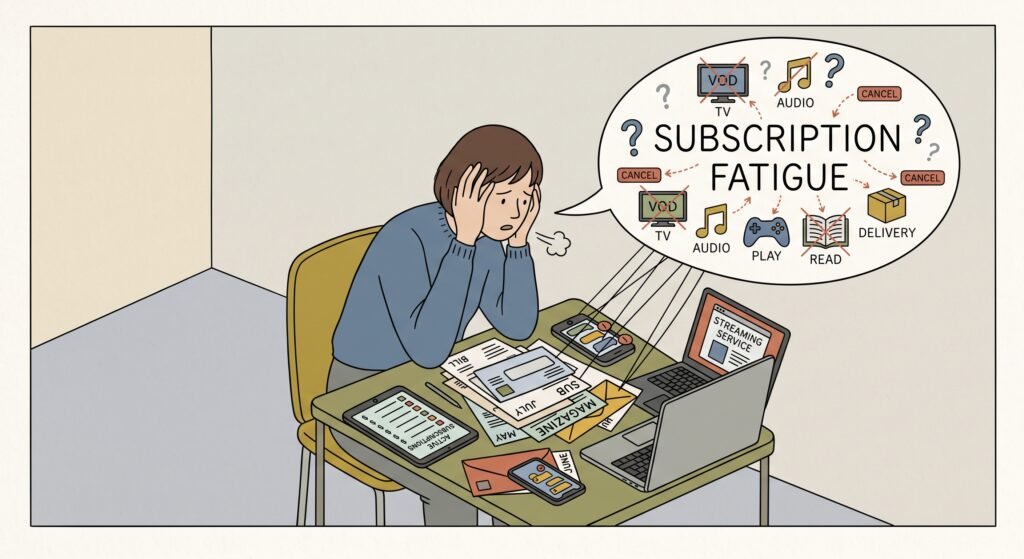
The issue isn’t that subscriptions are inherently bad or predatory. In many contexts, recurring revenue is the only sensible way to keep a business solvent and its servers running. The real problem(at least in my opinion) is that recurring billing has stopped being a conscious architectural choice and has instead become the unquestioned default business model for the entire tech industry. To the point where it happens even when the underlying economics of the software do not require it.
The Quiet Geometry of Subscription Creep
To see how pervasive this model has become, you only need to take an honest look at a typical monthly bank statement.
At the macro level, most of us manage the familiar household names: Netflix, Disney+, Prime Video, Spotify, YouTube Premium, or Apple One. Layered underneath those are the foundational utilities of modern life: extra phone storage, automated photo backups, password managers, VPNs, and daily productivity suites like Microsoft 365, Canva, or Adobe Creative Cloud. If you do any creative or technical work, you are likely paying for one or two AI services on top of that as well.
Where the fatigue really sets in, though, is in the sprawling territory of the micro-subscription.
These are the smaller, specialized apps that quietly accumulate in the background: the language-learning tool you open once or twice a week, the fitness tracker downloaded in January and forgotten about by June, the meditation timer that seemed like the perfect solution to a stressful week, the PDF utility you needed once, the vector editor, or the classroom resource platform that saved you time when reports were due.
None of these charges feels unreasonable on its own; three pounds here, five dollars there, or £2.49 billed every thirty days. That is precisely why the model works so well for businesses: the individual price point is low enough that it rarely triggers a cancellation or second thought.
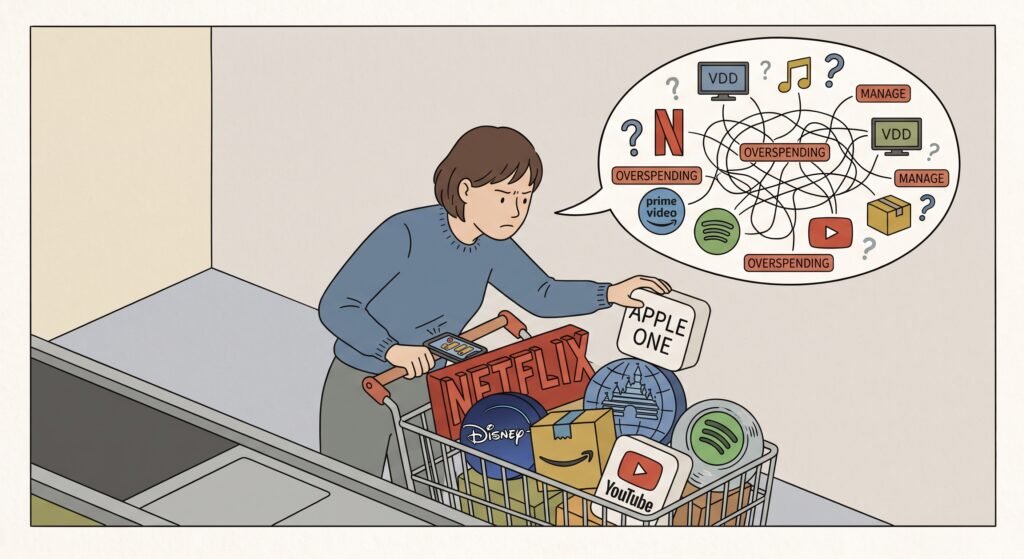
Yet the friction doesn’t come from the size of any single payment; it comes from the quiet accumulation. We have traded the upfront clarity of buying a tool for the perpetual mental overhead of renting dozens of small ones, constantly having to monitor, justify, or remember to cancel direct debits before the next renewal rolls around.
The Streaming Experiment and the Illusion of Access
Streaming is where most of us first bought into the subscription promise, and to be fair, the original proposition was fantastic. Instead of spending £15 on a single CD or buying physical DVDs that gathered dust on a shelf, a modest monthly payment unlocked an enormous, on-demand library. It felt genuinely transformative because the consumer value was undeniable. It was THE answer to piracy and argument people made of wanting a single song instead of the entire album.
Over time, however, the streaming ecosystem fragmented into half a dozen walled gardens. One service held the series you wanted, another had the films, another held the sports rights, and another had the children’s shows. Then they split up even further!
The original promise of “just subscribe to one service” collapsed.
Prices steadily climbed, catalogues rotated, favourite titles vanished overnight due to licensing renegotiations, and ad-supported tiers were quietly introduced to plans people were already paying for. Before long, we found ourselves paying multiple monthly bills just to recreate the basic experience of turning on a television.
There is nothing wrong with paying for entertainment you value, but this shift revealed a fundamental psychological difference between purchasing and renting:
Buying something gives you ownership; a subscription gives you continued access for as long as you keep feeding the meter.
When every tool becomes a rental, you never quite feel settled in your digital workspace. You are simply leasing access to someone else’s infrastructure, knowing that if you stop paying, your tools and your workflow disappear with it.
YouTube and the Layered Web
YouTube offers a fascinating contrast because so much of its foundational experience remains entirely free. Millions of hours of classroom tutorials, creative coding walkthroughs, music, and documentaries are openly accessible, supported by advertising and a massive creator economy.
Yet even here, the paid layers have steadily multiplied. Between YouTube Premium, YouTube Music, channel memberships, Super Thanks, and external Patreon tiers, the open web increasingly sits beside a growing thicket of paid micro-layers. And I get it, someone has to foot the bill!
None of these features are inherently negative. If you watch tutorials every day and despise adverts, Premium represents genuine value. If you are a creator, memberships provide a direct, reliable way for your community to support your work. What it highlights, though, is the broader direction of travel: users are constantly being asked to decide which digital gates they can afford to unlock just to navigate their daily routines.
The Infrastructure Line: When Recurring Models Make Sense
If we want to have a constructive conversation about subscriptions, we have to acknowledge where and when they are genuinely necessary. The clearest dividing line is cloud infrastructure.
Unlike an application that sits quietly on your laptop’s hard drive, cloud-hosted services carry real, unavoidable, day-to-day operating costs. If a company hosts gigabytes of your files, runs server-side computing, synchronizes relational databases in real time, or routes prompts through high-cost AI models, they incur a concrete expense for every active account.
Google One is a prime example. You receive 15GB of free storage with a Google Account, but if you need to store hundreds of gigabytes of classroom resources, teaching videos, or family photos across Drive, Gmail, and Google Photos, Google One covers that extra capacity.
That makes complete sense. If I store 500GB of data on somebody else’s servers and expect those files to be secure, backed up, and instantly accessible anywhere in the world five years from now, there is an ongoing cost to keeping the lights on. Expecting a company to maintain physical servers, bandwidth, redundancy, security, and electricity indefinitely for a one-off £10 payment simply isn’t realistic.
Not every subscription is built the same.
There is a fundamental difference between paying for continuous server infrastructure and paying every month for an application that runs entirely on your own device’s processor. That distinction gets swept under the carpet far too often.
Bundles and the Operating System Tax
To manage the growing consumer pushback against subscription sprawl, major platforms have increasingly turned to bundling.
Apple One is a masterclass in this strategy. Instead of asking you to make five separate purchasing decisions for Apple Music, Apple TV+, Apple Arcade, iCloud+, and Fitness+, they package them into a single monthly tier. On paper, it represents great value: if you genuinely use most of those services, your effective cost per service drops significantly, and five messy transactions become one clean invoice.
At the same time, bundling functions as an effective anaesthetic against subscription fatigue. You stop actively evaluating whether a specific tool is earning its keep because you are no longer thinking, “I am paying for five distinct services.” You simply think, “I have Apple One.”
Google uses a similar playbook by rolling storage, AI tools, and workspace perks into unified Google One tiers. The subscription doesn’t disappear; it simply recedes into the background, quietly turning into an ongoing operational tax on your digital life.
The Ultimate Frontier: Subscribing to the Hardware Itself
Lately, this philosophy has crossed the final boundary: moving from the software on the screen to the physical glass and aluminium in your hand.
With the shift toward programs like Apple Upgrade, the tech industry has taken the recurring model to its natural conclusion. On paper, it is framed around convenience and affordability: rather than dropping up to £2,000 upfront or taking out a traditional interest-bearing credit loan(or free 0% instalment plan through the companies offering this), you pay a lower monthly fee to lease the device. When the new flagship model arrives twelve or twenty-four months later, you simply hand the old hardware back, refresh your contract, and unbox the latest phone.
Strictly speaking, it is structured as a financial lease rather than a pure software subscription, but psychologically and practically, the effect is identical. You aren’t buying a phone anymore. You are subscribing to a device tier.
On the surface, you can see why it appeals. It removes the friction of upfront retail prices, automates the trade-in process, and guarantees that you always have modern hardware in your pocket. But notice how quietly it dissolves the last remaining pillar of consumer ownership.
When you buy a phone outright, you hold an asset. Even when it begins to feel dated three or four years down the line, that device retains tangible utility: you can pass it down to your children for schoolwork or as their first device, repurpose it as a dedicated camera in the classroom, keep it in a drawer as an emergency backup, or sell it on the second-hand market to recoup part of your initial cost.
Under a continuous upgrade lease, that residual value evaporates. If you stop paying your monthly fee, you don’t just miss out on the next software patch, you literally have to post the physical phone back. The hardware itself ceases to be a tool you own and becomes another permanent, non-negotiable utility bill, sitting alongside your water, electricity, and broadband.
Once both the physical hardware and the operating system inside it are rented on a rolling cycle, the subscription model is no longer just a way to sell software. It has become the entire architecture of personal computing.
When Subscriptions Become a Default Business Habit
This brings us to the core problem: what happens when recurring billing is applied to tools that have no technical need for it?
We see this across everyday utilities and educational platforms alike. From language apps restricting basic practice behind subscription tiers to classroom platforms bundling multiple apps under single premium packages, the business motivation is obvious. Recurring revenue provides predictable cash flow, keeps investors happy, and maximizes customer lifetime value.
From a user’s perspective, however, the digital landscape starts to feel like a maze of tollbooths. One subscription unlocks an export button, another removes a watermark, another enables offline access, and another allows you to sync to a second device. Before long, you aren’t really buying software anymore, you are renting an entire ecosystem just to do basic work.
This dynamic is especially frustrating in education. Teachers, computing leads, and students need tools that are reliable, open, and immediate. When a lesson depends on a digital tool, an educator needs to know that every child can open the app and achieve the learning objective without running into a paywall, a forced login, or a trial countdown five minutes into class.
The Amber Philosophy: Useful First, Sustainable Second
This tension is precisely what shaped my approach when building the Amber ecosystem, including tools like AmberJr, AmberCodes, and AmberPuppets.
I deliberately wanted to step away from the standard software playbook that treats every user interaction as a funnel toward an automatic monthly renewal. Instead, the focus has been on building local-first, privacy-respecting tools designed around three simple principles:
- A genuinely useful free tier. The core experience of an app shouldn’t be a broken demo designed to frustrate users into upgrading. In AmberJr, AmberCodes and AmberPuppets, students and teachers can build complete creative coding projects and digital puppetry animations without ever hitting an artificial barrier.
- One-time purchases for local software. If an application does its heavy lifting locally on your device, relying on your own processor and local storage, there is no massive ongoing server bill being generated every time you open it. The development work, testing, and developer account fees are real, but they are best honoured through a straightforward, one-time Pro purchase. You pay once, unlock the extra features, and own the tool.
- An interconnected ecosystem without individual paywalls. Rather than releasing standalone apps that each demand their own direct debit, the Amber tools share resources, creative assets, and accounts to keep access as open and affordable as possible.
When an educator recommends a tool to a colleague, the conversation shouldn’t be about whether the department budget can absorb another annual subscription. It should simply be: “Go and try it. It works, and it’s free.” Then if you find real value, upgrade for more or to say thank you.
Subscriptions Done Right: The Emerald Lens Approach
That doesn’t mean recurring models have no place in independent software; it just means they need to be applied honestly.
Take Emerald Lens, a tool built for structured note-taking alongside instructional video. The original version was architected with a strict local-first approach: you can open the tool in your browser, take notes, and keep your files stored locally on your machine without creating an account or sending data to a remote database. Because the processing happens on the client side, additional users don’t generate mounting server bills, allowing the core tool to remain completely free.
Eventually, users asked for a very natural feature: the ability to sync notes seamlessly across multiple devices.
The moment you introduce cloud synchronization, the technical reality changes. Storing user data remotely requires dedicated cloud databases, secure authentication, automated backups, and continuous bandwidth. That infrastructure costs money every single month.
To support that, Emerald Lens offers a low-cost subscription for cloud sync, priced modestly, to cover the actual infrastructure rather than to build a venture-backed revenue engine. Crucially, the core application remains entirely free. If you only need local note-taking, you never pay a penny; you only subscribe if you choose to use the cloud infrastructure that costs me money to run.
Finding the Third Way
The answer to subscription fatigue isn’t to demand that all software be free. Software development takes considerable time, developers need to earn a living, and maintaining infrastructure carries real expenses.
What we need is a more honest alignment between the architecture of a product and how we pay for it.
Instead of accepting subscription billing as the default, we should encourage developers and creators to match the payment model to the product:
- If an app runs locally on user hardware, make it free or offer an honest one-time purchase or upgrade for pro-features.
- If a service relies on continuous cloud storage or heavy AI compute, explain the infrastructure costs and offer a transparent, reasonably priced subscription.
- If a tool offers a free tier, ensure it provides genuine standalone utility rather than serving as an artificial barrier. If the free tool doesnt work without a payment, you’ve already lost!
People don’t mind paying for well-crafted software that makes their lives easier or enriches their classrooms. What they are exhausted by is the feeling of being perpetually billed for tools that never truly belong to them.
The future of software doesn’t have to be a binary choice(see what I’ve done there) between aggressive ad-driven free tiers and endless monthly subscriptions. There is a third option: tools that are useful first, sustainable second, and occasionally, something you simply buy once and enjoy.
The Amber Projects
If you’d like to explore how this philosophy translates into actual tools, you can check out various projects I’m involved in:
- AmberJr – Creative assets, characters, and curriculum tools designed for ScratchJr and early-years creative coding.
- AmberCodes – Interactive tools and coding environments focused on computational thinking and creative computer science.
- AmberPuppets – Digital puppetry and storytelling tools that bring pupil-led animation into the classroom without complex setups.
- Emerald Lens – Structured note-taking alongside YouTube tutorials. The core tool is free and runs in your browser; an optional, low-cost subscription is available if you need multi-device cloud synchronisation.
Coming soon to the App Store. - Amber Animator – A Stop-Motion animation app The core app is free to download and use, with all core features fully accessible. There is a one-time Pro purchase for advanced features and to support ongoing development.
- Unplugged Podcast Maker – An easy, local-first recording studio where children can create, edit, and export their very first podcast with fun sound and voice effects. Completely private with zero data collection. The app is free to use with full access to everyday features, supported by an optional one-time Pro upgrade for additional sound effects or to say thank you to the devs.