
Yesterday with Steve Katz and Lii Jing (21st century learning) and our sponsors Steelcase we hosted the latest TeachmeetKL. One of the things I love about TeachMeets is that teachers share ideas that have come directly from their classrooms. You come away with something you can actually try the next morning.
Across six very different presentations, a theme emerged for me: how do we get students to do more of the thinking? Whether we are talking about artificial intelligence, exam feedback, robotics or behaviour, the quality of the learning depends on what the students themselves are doing.
Less screen, more thinking
Hooi Ping from elc International School, Cyberjaya, shared her experience of moving from a technology-rich Global Perspectives classroom to a much lower-tech History classroom. With fewer digital resources, she had to reconsider how she planned lessons, used printed sources and encouraged discussion.
Her presentation also gave an example of students using ChatGPT while preparing for the John Locke Essay Competition. Two students received commendations. The important point was that AI could help students explore ideas and test arguments, but they still needed to verify evidence and take ownership of their writing.
As someone who champions digital learning, I think this is a healthy challenge. We should be asking whether the technology adds something meaningful to the lesson.
Making thinking visible
Priya Abimanyu, an EAL teacher at the International School @ ParkCity, highlighted the difference between understanding a concept and having the language to explain it. Imagine trying to explain the water cycle without using the words water, cloud, rain or sun. You might understand the science perfectly and still struggle to communicate it.
Priya shared practical strategies including teacher modelling, sentence frames, think-pair-share, hot seating and information gap activities. The aim is to maintain the intellectual challenge while providing different levels of language support, gradually removing that support as learners become more independent.
Mistakes to mastery
Valerie Quaye from The Alice Smith School presented a particularly practical approach to getting students to act on assessment feedback. The problem is familiar: we spend hours marking a test, students look at their grade, the paper goes into a folder and the same mistakes appear in the next test.
Val’s solution is to dedicate a lesson to doing something about those mistakes. Students first mark their own paper before seeing the teacher’s mark allocation. They then classify each lost mark using four codes:
- K – Knowledge: I did not know the content.
- C – Command word: I gave the wrong type of answer.
- D – Detail: My answer was too vague or lacked a key term.
- T – Time: I ran out of time.
Students study the mark scheme or their notes, close them and rewrite their three weakest answers from memory. They can then attempt a fresh question to see whether the learning has stuck.
I particularly like the fact that this gives students a specific next step. Revising a topic is very different from practising how to answer an extended question or learning to manage exam time. It also needs nothing more elaborate than a paper, a mark scheme and a different coloured pen.
Building a classroom community
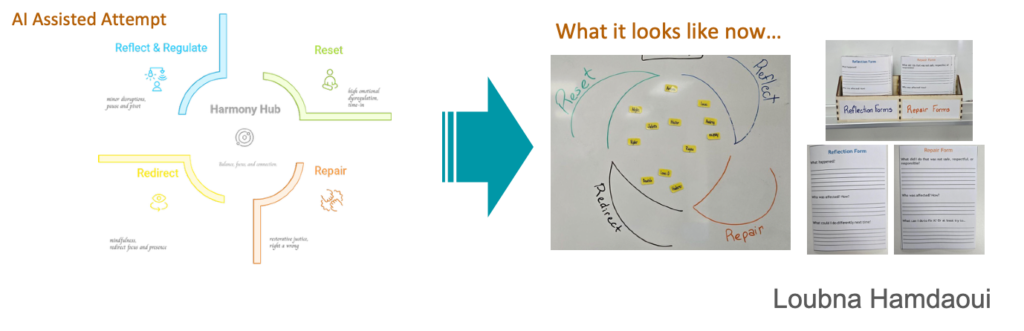
Loubna Hamdaoui shared her Classroom Community Compass, an approach to emotional regulation and accountability which developed from a simple tally system into a more restorative classroom tool.
Her compass uses four routes: reset, reflect, redirect and repair. Students have access to reflection and repair forms that encourage them to consider what happened, who was affected and what they could do differently or how they could put things right.
Interestingly, Loubna used AI to help explore the initial design, but the classroom implementation was a physical whiteboard and printed forms. This is a good example of technology helping a teacher develop an idea without requiring students to use technology at all.
Robotics beyond the cupboard
Kenton McElhone discussed the place of robotics in a future-ready curriculum, including the very real danger of expensive equipment ending up in a dusty cupboard. Buying kits is only the first step. Staff confidence, curriculum planning and continuity all matter.
He suggested embedding robotics into everyday learning goals, starting with enthusiastic teachers and building wider support. Clubs and competitions are another route, but relying entirely on one enthusiastic member of staff creates a risk when that person moves on.
This resonates with anyone who has introduced new technology across a school. Before buying a kit, we should be asking who will teach with it, what students will learn and how we will sustain the programme in subsequent years. Robotics has enormous potential to make computing tangible: students can build, test and debug something in the physical world.
Digital entrepreneurship with a purpose
The AIMS Entrepreneurship Challenge takes another approach to learning with technology. Students identify a real educational problem, research it and pitch a proposed solution in a two-minute video. They must consider how to use AI responsibly and ethically and produce a digital mock-up.
If you are a Malaysian school and want to get involved, then have a look at the Teacher interest sheet: https://sites.google.com/gardenschool.edu.my/aiment/home
JSFUN resources
I showcased a few resources from JSFUN where I keep a lot of the tools that help teachers in my network. The site is here: https://jamesabela.github.io/jsfun/
- 3D Lollipop Carousel (We used this to randomly pick the presenters)
- Think Rank Studio to help students think and understand the cognitive load of each tool.
- Optical Reading Studio to help students empathise with the kind of experience a dyslexic student might have.
After the event we discussed Vibe Coding and if you’d like to learn how to do it safely then join my workshop which finally comes to KL in January. We also discussed my Python coding platform.
What can we take back to our classrooms?
These presentations provide some achievable starting points:
- Ask students to explain their thinking before reaching for a digital tool.
- Use sentence frames to help students articulate complex ideas.
- Dedicate time after an assessment to correcting mistakes and attempting new questions.
- Give students a constructive way to reflect on behaviour and repair relationships.
- Plan robotics around curriculum objectives before investing in equipment.
- Challenge students to build technology that solves a genuine problem.
There is a danger that our discussions about the future of education become dominated by the latest technology. What I took from this TeachMeet is that the question we should keep returning to is much simpler: what is the student learning, and how do we know?
Thank you to all of our presenters, to 21st Century Learning, to Steelcase for hosting us and to everyone who joined the conversation. The real value of a TeachMeet is what happens afterwards, when someone takes an idea from another classroom and makes it their own.
Presentations and pictures can be found here>>
