
A Simple Comparison Using Everyday Classroom Activities
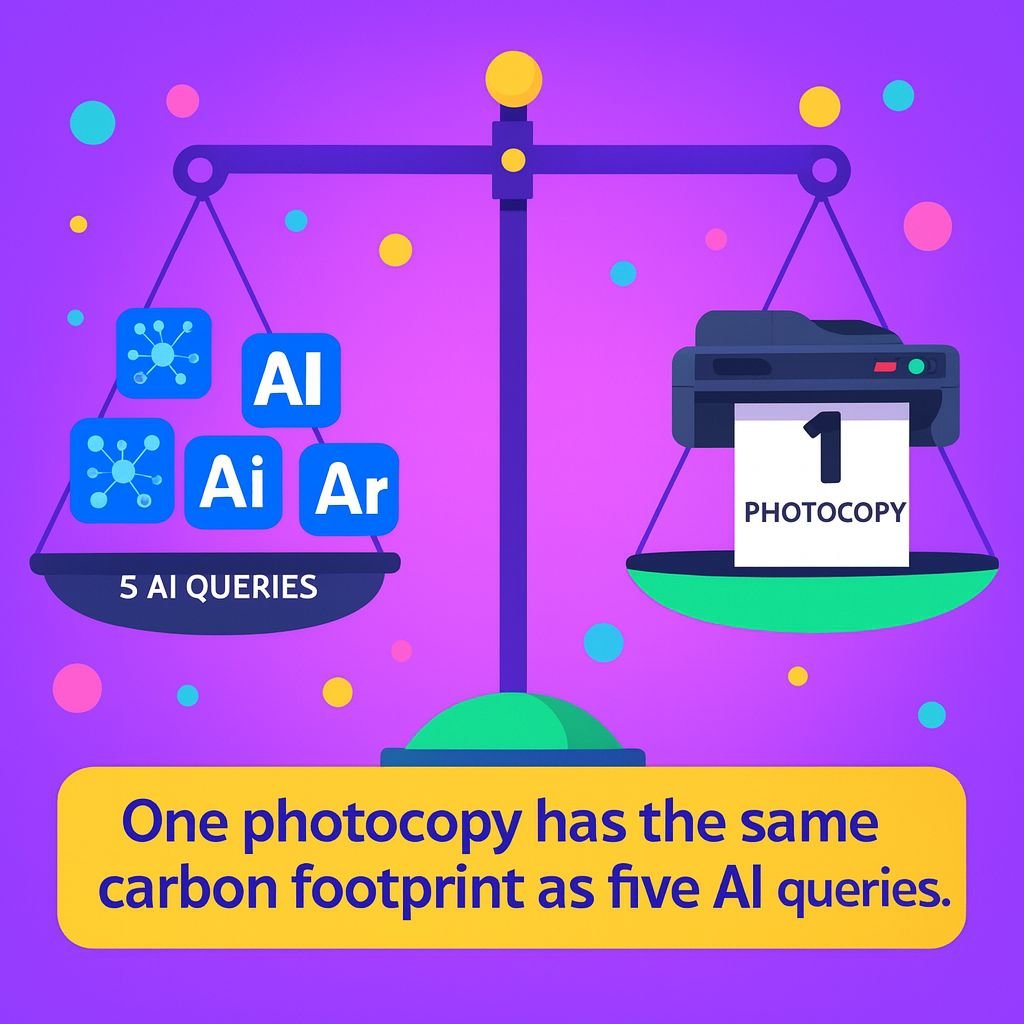
When you search the internet or ask a question to an AI system, energy is used to process your request. Some actions use very little energy, while others require far more. To help make sense of this, we compare AI queries to something everyone understands: photocopying.
The Short Answer
- 1 standard Google search uses a very small amount of energy.
- 1 AI query (ChatGPT, Gemini, etc.) uses around 10 times more energy than a normal search.
- Photocopying, once you include paper manufacturing, toner, and electricity, uses more energy than both digital tasks.
This article explains how they compare.
⚡ AI Energy Playground
Move the sliders to choose how many AI questions and normal searches you use. Then see what that energy is roughly equal to in photocopies, phone charges, light bulbs and more.
📊 Results
AI question: 3 Wh, normal search: 0.3 Wh, photocopy (paper + toner + electricity): 15 Wh,
phone charge: 10 Wh, 3 W LED light for 1 hour: 3 Wh, 1 minute kettle boil: 33 Wh, 1 hour HD streaming: 75 Wh.
Wh means “watt hour” and is a way to measure energy.
1. Energy Used per Query
We measure energy in Watt-hours (Wh).
Standard Search
0.3 Wh per search
This is extremely efficient because search engines use indexes to retrieve information quickly.
AI Query
3 Wh per query
A large language model generates an answer word by word, requiring billions of calculations.
2. The Real Energy Behind a Photocopy
Photocopying is often assumed to be energy-light, because the machine itself uses little electricity.
However, a proper carbon and energy footprint includes:
- the electricity used by the photocopier,
- the energy used to produce the A4 paper,
- the energy and materials in toner manufacturing,
- packaging and transportation.
Environmental studies give a typical A4 photocopy a total footprint of:
- 5 to 20 Wh per sheet of energy equivalent
- 4 to 6 grams of CO₂e per sheet
To keep comparisons simple, we use a reliable mid-range value:
One A4 photocopy ≈ 15 Wh (total lifecycle impact)
This means photocopying is mainly an environmental issue not because of electricity, but because of paper production.
3. AI Queries vs Photocopying
Using the figures above:
- 1 AI query (3 Wh)
≈ 0.2 photocopies - 1 photocopy (15 Wh)
= about 5 AI queries
Put another way
| Activity | Energy Used | Equivalent in AI Queries |
|---|---|---|
| 1 Standard Search | 0.3 Wh | 0.1 AI queries |
| 1 AI Query | 3 Wh | 1 AI query |
| 1 Photocopy (full impact) | 15 Wh | 5 AI queries |
| 20 Photocopies | 300 Wh | 100 AI queries |
| 100 Photocopies | 1,500 Wh | 500 AI queries |
4. Other Everyday Equivalents
These comparisons help students and teachers understand digital energy use in context.
Charging a Smartphone
8 to 12 Wh
≈ 3–4 AI queries
Running a 3 W LED bulb for 1 hour
3 Wh
≈ 1 AI query
Boiling a kettle for 1 minute
33 Wh
≈ 11 AI queries
Streaming HD video for 1 hour
50 to 100 Wh
≈ 17–33 AI queries
5. Flights
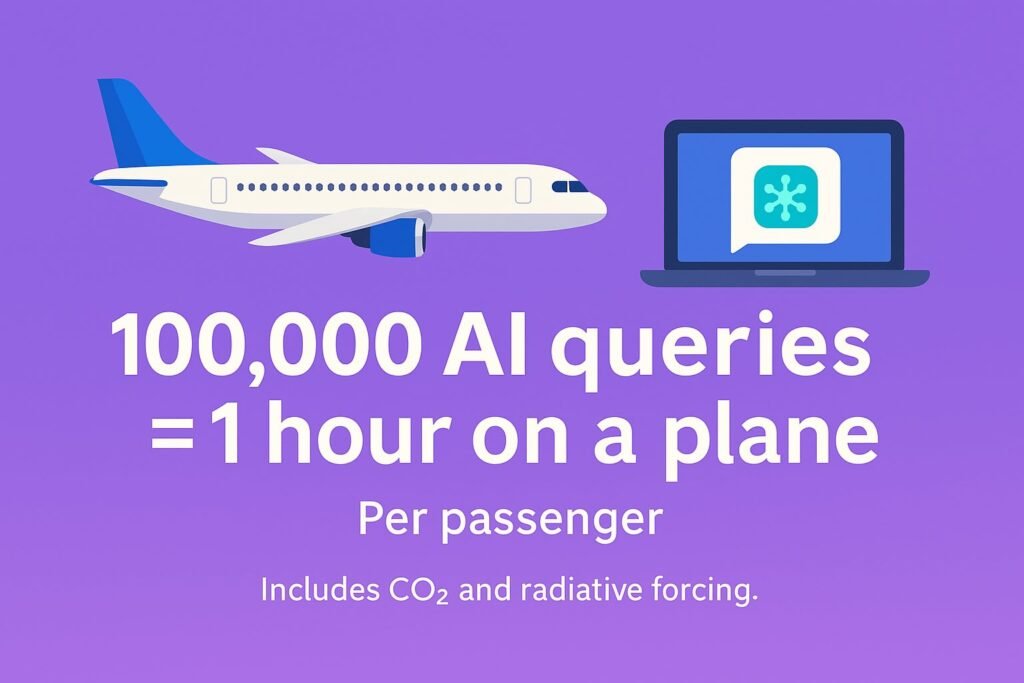
1 passenger on a 5 hour flight on a modern plane would be about 500,000 queries!
| Aircraft type | Typical example | CO2e per passenger per hour (kg) | CO2e over 5 hours (kg) | Equivalent ChatGPT queries |
|---|---|---|---|---|
| Modern narrow-body | Airbus A320neo | ~135 | ~675 | ~505,000 |
| Older narrow-body | Boeing 737-400 | ~170 | ~850 | ~640,000 |
| Modern wide-body | Airbus A350 / Boeing 787 | ~130 | ~650 | ~485,000 |
| Older wide-body | Boeing 747-400 | ~175 | ~875 | ~655,000 |
| Private jet (light) | Citation CJ2 (2–4 pax) | ~450 | ~2,250 | ~1,690,000 |
| Private jet (mid-size) | Gulfstream G200 (6–8 pax) | ~675 | ~3,375 | ~2,530,000 |
| Private jet (heavy) | Gulfstream G650 (10–15 pax) | ~1,050 | ~5,250 | ~3,930,000 |
Final Summary
- A standard search uses very little energy.
- An AI query uses about 3 Wh, similar to running a small LED bulb for an hour or one-third of a phone charge.
- A photocopy, when you include the impact of paper and toner, uses five times more energy than an AI query.
- This means 100 AI queries have roughly the same total energy impact as 20 photocopies.
References
Apple Inc. (2025, April 16). iPhone battery and performance. Apple Support.
https://support.apple.com/en-my/101575
Air Transport Action Group. (2023). Facts and figures: Climate change.
https://atag.org/facts-figures/climate-change
Carbon Independent. (2019). Aviation emissions calculations.
https://www.carbonindependent.org/sources_aviation.html
De Vries, A. (2023). The growing energy footprint of artificial intelligence. Joule, 7(10), 2191-2194.
https://doi.org/10.1016/j.joule.2023.09.004
Dias, A. C., & Arroja, L. (2011). Comparison of methodologies for estimating the carbon footprint: Case study of office paper. Journal of Cleaner Production, 24, 30-35.
https://doi.org/10.1016/j.jclepro.2011.11.005
Google. (n.d.). Power usage effectiveness. Google Data Centers.
https://datacenters.google/efficiency/
Intergovernmental Panel on Climate Change. (2021). Climate change 2021: The physical science basis. Contribution of Working Group I to the Sixth Assessment Report. Cambridge University Press.
https://www.ipcc.ch/report/ar6/wg1/
International Energy Agency. (2023). CO2 emissions from fuel combustion 2023.
https://www.iea.org/reports/co2-emissions-from-fuel-combustion-2023
International Energy Agency. (n.d.). Electricity 2024. World Energy Outlook 2025. Retrieved November 19, 2025, from
https://www.iea.org/reports/electricity-2024
Lee, D. S., Fahey, D. W., Skowron, A., Allen, M. R., Burkhardt, U., Chen, Q., Doherty, S. J., Freeman, S., Forster, P. M., Fuglestvedt, J., Gettelman, A., De Leon, R. R., Lim, L. L., Lund, M. T., Millar, R. J., Owen, B., Penner, J. E., Pitari, G., Prather, M. J., Sausen, R., & Wilcox, L. J. (2021). The contribution of global aviation to anthropogenic climate forcing for 2000 to 2018. Atmospheric Environment, 244, 117834.
https://doi.org/10.1016/j.atmosenv.2020.117834
Signify Holding. (2023). State-of-the-art LED light bulb for the home.
Transport & Environment. (2023). Private jets: Can the super-rich fly greener?
https://www.transportenvironment.org/discover/private-jets-can-the-super-rich-fly-greener/
UK Committee on Climate Change. (2020). Sixth carbon budget: Aviation.
https://www.theccc.org.uk/publication/sixth-carbon-budget/
