
Luis Francisco Vargas-Madriz, an analyst at the OECD, explains why schools must move beyond teaching students how to use artificial intelligence and develop the judgement needed to evaluate, manage and shape it.
Artificial intelligence is already part of young people’s everyday lives.
Students use AI to search for information, support their learning, generate creative work and answer questions. However, Luis Francisco Vargas-Madriz, an analyst at the OECD, warns that many students have received little formal guidance about how these systems work or how their outputs should be evaluated.
The challenge for education systems is therefore not simply whether students should be allowed to use AI. It is whether they are being taught to use it critically, safely and responsibly.
Students may know how to enter a prompt and obtain a polished answer, but this does not mean they can recognise bias, assess its reliability or understand the human choices behind the system. Vargas-Madriz argues that schools must close the gap between the widespread use of AI and the development of genuine AI literacy.
AI literacy is about more than using a tool
For Vargas-Madriz, the educational opportunity is not simply the technology itself, but what students can learn to do with it.
AI can support creativity, exploration and learning. However, its value depends on how students engage with it. A learner who accepts a confident answer without examination may complete a task successfully without developing deeper understanding.
Schools must therefore design learning experiences that place critical thinking at the centre of AI use. Students should be expected to:
- Question an AI-generated response
- Compare it with reliable evidence
- Identify assumptions or missing information
- Consider possible bias
- Decide whether using AI is appropriate for the task
Vargas-Madriz also connects AI literacy with broader skills such as creativity, information literacy and responsible decision-making. These abilities should not be treated as optional additions to technical knowledge. They are central to using AI well.
Two complementary international frameworks
During the interview, Vargas-Madriz discussed two related but distinct international initiatives.
The first is the PISA 2029 Media and Artificial Intelligence Literacy assessment, known as MAIL.
The second is Empowering Learners for the Age of AI: An AI Literacy Framework for Primary and Secondary Education, jointly developed by the OECD and the European Commission.
Although the two initiatives complement each other, they have different purposes.
MAIL is an assessment framework intended to examine what students can do in realistic media and AI situations. The OECD-European Commission framework is a practical reference intended to help teachers, school leaders, policymakers and curriculum designers develop those capabilities.
PISA 2029 Media and Artificial Intelligence Literacy
The OECD defines media and artificial intelligence literacy as the competences needed to engage effectively, ethically and responsibly with digital content, media platforms and AI systems.
The planned PISA 2029 MAIL assessment will combine more traditional questions with simulated environments resembling the internet, social media and AI tools. Students may be asked to judge the credibility and purpose of digital content, evaluate AI-generated outputs and make informed decisions about how they participate online. (OECD)
This reflects Vargas-Madriz’s description of an assessment based on authentic situations rather than conventional recall questions.
Students might be asked to:
- Validate an AI-generated response
- Identify possible bias in an algorithm
- Evaluate the reliability of digital content
- Decide whether information should be shared
- Consider the ethical consequences of an online action
The aim is not merely to test what students know about AI. It is to observe whether they can apply their knowledge, skills and attitudes when making decisions.
The current MAIL assessment framework is still a preliminary draft and may be revised before its official release. Results from the PISA 2029 assessment are expected in December 2031. (OECD)
A classroom framework for AI literacy
The OECD-European Commission framework serves a different purpose.
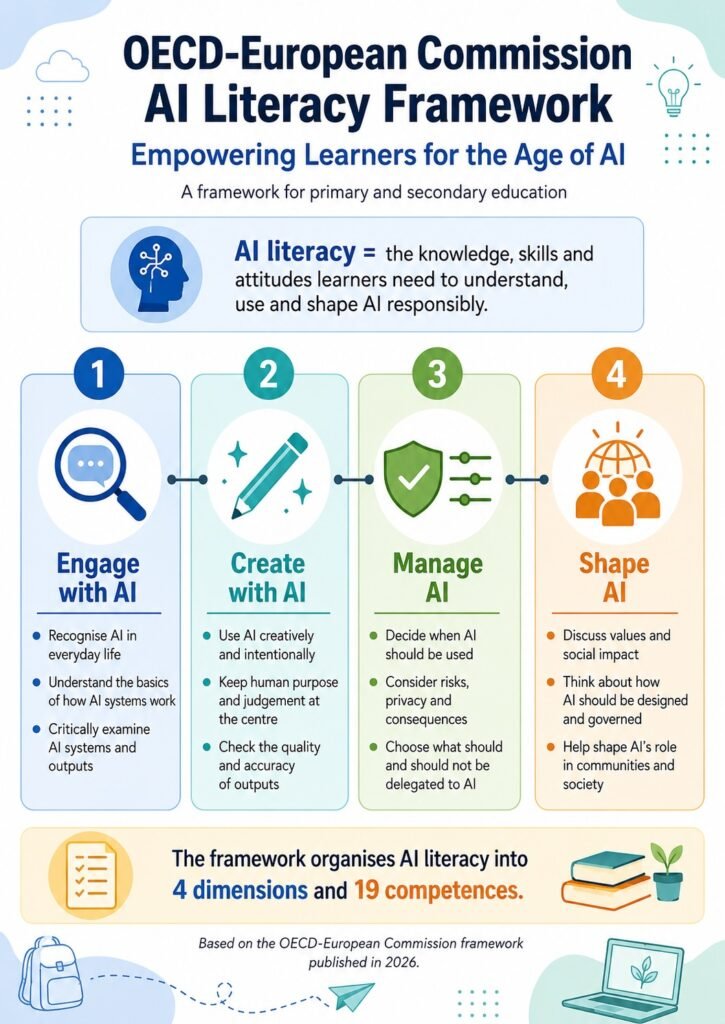
Published in June 2026, Empowering Learners for the Age of AI provides a common framework for AI literacy in primary and secondary education. It describes AI literacy as a combination of knowledge, skills and attitudes that helps learners understand AI systems, evaluate their outputs and use them ethically and creatively. (OECD)
The framework contains 19 competences organised across four dimensions:
- Engage with AI
- Create with AI
- Manage AI
- Shape AI
It also provides learner expectations, learning scenarios and classroom examples to help schools turn the framework into practical learning experiences. (European Education Area)
Engage with AI
The first dimension involves recognising AI and developing an understanding of how AI systems operate.
Students should be able to notice where AI is present in their lives, including search engines, recommendation systems, automated decisions and generative tools.
They also need to understand that AI outputs are shaped by data, system design and human decisions. An AI-generated answer is not an independent or neutral statement of fact.
Engagement therefore includes both basic technical understanding and critical evaluation.
Create with AI
Students should learn to use AI creatively and intentionally.
The purpose is not simply to produce content more quickly. Students need to understand why they are using AI, what contribution they are making themselves and how they will judge the quality of the result.
This raises important questions:
- Is AI helping the learner develop an idea or replacing the thinking?
- Who is responsible for the final product?
- How should AI assistance be acknowledged?
- Does the output reflect the student’s intentions?
- Has the student checked whether it is accurate?
Creating with AI should remain an active human process rather than the passive acceptance of generated material.
Manage AI
Managing AI means deciding when, why and how a task should be delegated to an AI system.
Students must learn that just because AI can perform a task does not mean it should.
They should consider whether using AI will support their learning, whether personal data may be exposed and whether the system is reliable enough for the situation.
This dimension develops judgement. It asks students to make deliberate choices rather than using AI automatically.
Shape AI
The final dimension moves students from being users of AI towards becoming participants in decisions about its future.
Students consider the values AI systems should reflect, how they affect communities and how they might be designed or governed differently.
Vargas-Madriz described this progression as a movement from a relatively passive role towards greater agency. Students should not merely accept the technology they are given. They should be able to discuss what they want AI systems to do and what impact those systems should have within society.
Students must understand that AI is not neutral
Vargas-Madriz connected AI literacy with familiar ideas from media literacy.
Students have long been taught to ask who created a message, why it was created and whose perspective it represents. These questions become even more important when the content has been generated or selected by AI.
He highlighted three areas of enquiry.
Authors and audiences
Students should consider who influenced a digital message and who it is intended to reach.
AI-generated material is shaped by training data, system design, developer decisions and the instructions provided by the user. Although the final output may appear automatic, human choices remain embedded within it.
Messages and meanings
Students should examine the values, assumptions and viewpoints contained within a response.
AI systems can reproduce patterns and biases found in their training data. Their answers should not automatically be treated as balanced or objective.
Representations and realities
Students must consider whether a piece of content accurately represents the real world.
Synthetic text, images, audio and video can appear highly convincing. Something that looks or sounds realistic is not necessarily authentic or trustworthy.
Students need to examine evidence, context, purpose and sources before deciding whether to believe or share it.
Vargas-Madriz captured this shift with a memorable idea: the task for this generation may not simply be to answer questions, but to question the answers.
The risks extend beyond schoolwork
AI literacy is not only an academic issue.
Vargas-Madriz also raised concerns about young people using AI systems for personal and emotional conversations.
Some students may discuss experiences or feelings with AI that they find difficult to share with another person. The system may respond in a way that appears caring or supportive, but it cannot provide genuine human understanding.
Students may also disclose private or sensitive information without understanding how that data could be used or stored.
Vargas-Madriz argues that healthy emotional development depends on trust, reciprocity and genuine human connection. AI may imitate aspects of supportive conversation, but it cannot replace an appropriate relationship with a trusted adult, friend or professional.
Schools should therefore teach students:
- What information should remain private
- Why an AI response may be misleading
- When AI is not an appropriate source of support
- When they should seek help from a trusted person
- Why a human-sounding response is not the same as human care
AI literacy must include privacy, safeguarding and wellbeing alongside technical and academic skills.
AI literacy belongs across the curriculum
One of Vargas-Madriz’s clearest messages for school leaders is that AI should not be treated only as a technology problem.
Schools may be tempted to respond by purchasing platforms, selecting approved tools or publishing a policy. These steps may be useful, but they do not address the deeper educational challenge.
He argues that schools need to create a culture of critical thinking across the curriculum.
In science, students might compare an AI-generated summary with the original research.
In history, they might investigate the reliability and origins of digital sources.
In English, they might examine voice, authorship and the choices involved in producing a text.
In art, music or drama, students could explore creativity, ownership and human intention.
In personal and social education, they might discuss privacy, wellbeing and emotional dependence on technology.
AI literacy should therefore not be left entirely to computing teachers. It belongs wherever students encounter information, create media or make decisions.
Teachers need sustained support
Vargas-Madriz acknowledges that teachers are already stretched. Schools should avoid introducing AI as another initiative staff must master independently.
However, the teaching profession appears ready to engage.
OECD data published in the 2026 Digital Education Outlook reports that 37 per cent of lower-secondary teachers used AI for their work in 2024. It also found that 57 per cent believed AI could help with writing or improving lesson plans, while 72 per cent believed it could harm academic integrity by allowing students to present AI-generated work as their own. (OECD)
Vargas-Madriz argues that teachers need targeted and contextualised professional learning. A single workshop may introduce a tool or begin a discussion, but sustained classroom change requires continuing support.
Teachers need opportunities to:
- Experiment within their subject
- Examine examples of student use
- Discuss ethical and safeguarding concerns
- Redesign learning activities
- Share practice with colleagues
- Review the effect on student learning
Early investment in suitable professional development can reduce the support and resources teachers require later.
The goal should not be to require every teacher to use AI. It should be to ensure that teachers know enough to make informed professional decisions about when it should and should not be used.
Start the conversation now
Vargas-Madriz ended with a practical recommendation: schools should not wait for the perfect tool, policy or professional development programme.
They should begin by talking to teachers.
Ask:
- What are you already seeing in your classroom?
- How are students using AI?
- What concerns do you have?
- What support do you need?
- Where might AI strengthen or weaken learning?
Schools should also speak directly to students.
Ask:
- How are you currently using AI?
- What do you think it does well?
- When has it been inaccurate or unhelpful?
- What risks have you noticed?
- What guidance would help you?
Students are already participating in the AI environment. They should also participate in discussions about how their schools respond to it.
Teaching students to remain active thinkers
The message from Vargas-Madriz is not that schools should embrace every AI tool or attempt to prohibit the technology entirely.
Instead, schools must help students become thoughtful and responsible users.
Students need to know how to use AI, but they must also understand when not to use it. They need to question how an answer was produced, what it may have omitted and whose interests it might represent.
The two OECD initiatives offer complementary support for this work.
The PISA 2029 MAIL assessment will examine whether students can apply media and AI literacy in realistic situations. The OECD-European Commission framework helps schools define and develop the competences students will need.
Schools cannot write a rule for every possible use of AI. The technology is developing too quickly.
They can, however, develop learners who pause, question, verify and make informed decisions.
That may be the most important form of AI literacy education can provide.
About Luis Francisco Vargas-Madriz
He joined the PISA team in August 2022 to support the Research, Development, and Innovation (RDI) Programme, and more recently to support the development and implementation of the PISA 2029 Innovative Domain Assessment. Before joining the OECD, he worked on a variety of quantitative, qualitative, and mixed-methods research projects in the areas of educational technology, educational psychology, and human development (social-emotional learning) in both secondary (middle, and high school) and tertiary (college, and university) school settings.
