
Attending the panel session on AI in education at Apple’s recent “Designed for Every Kind of Learner – Kuala Lumpur” Summit offered a fascinating look at how two distinct worlds, and two vastly different educational tiers, are grappling with artificial intelligence. Listening to Francis Jim Tuscano (Grade School Assistant Principal for Academics at Xavier School) and Dr. Joseph Benjamin Ilagan (Director of the Ateneo BUILD Lab) share the stage provided a rich, yet balanced perspective. On one side, you had a dedicated K–12 academic leader balancing primary pedagogy and curriculum guardrails; on the other, a veteran software developer who spent 30 years in enterprise tech before bringing a “builder mindset” into higher education seven years ago.
Taming Administrative Burnout in K–12
Jim’s presentation grounded the conversation in the harsh realities of teacher workload. He highlighted a striking study revealing that public school teachers in Metro Manila spent an average of 35 hours per week on non-instructional, administrative tasks, with over 20 hours swallowed up by lesson planning alone. Whilst I realise this will come as no surprise to all the educators reading this, seeing it laid out in hard research data does hit differently.
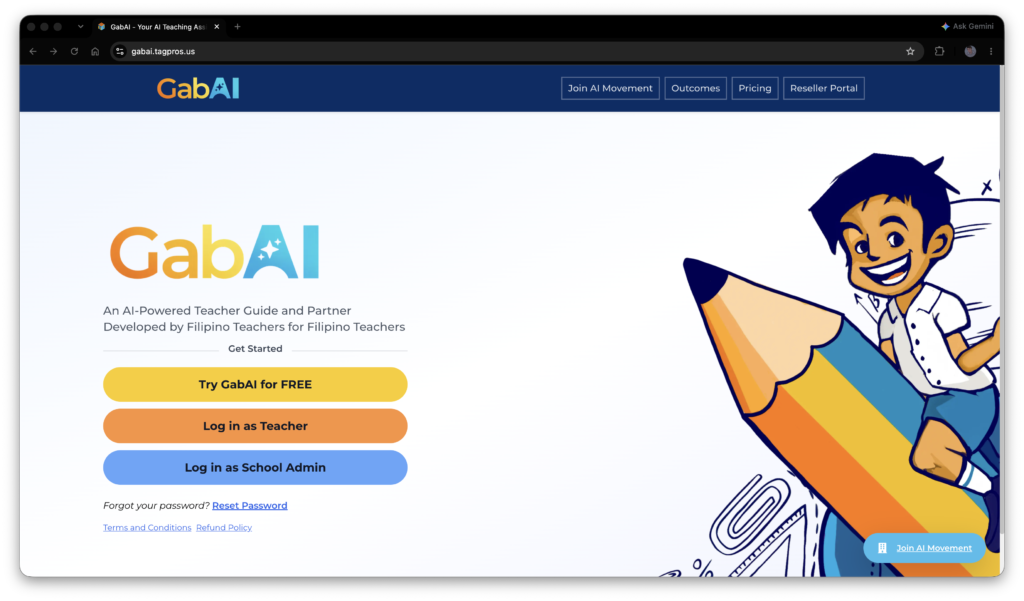
To help address this administrative drag, his team helped deploy GabAI (“Guide”), an AI assistant tailored specifically to the local K–12 curriculum. The impact on planning efficiency was undeniable:
- Baseline Planning Time: 22.7 hours/week
- Initial AI Adoption: Dropped to 5.1 hours/week
- Sustained AI Users: Settled at 3.5 hours/week
What made Jim’s perspective particularly grounded, however, was his insistence on developmental appropriateness. In primary education, he advocated for keeping generative AI almost entirely teacher-facing. His argument was simple: if a young learner is still building foundational numeracy and literacy (establishing that $1 + 1 = 2$), they lack the schema required to spot an AI hallucination if it tells them $1 + 1 = 4$. In his opinion, direct student interaction with AI belongs in secondary school, where students have built the critical thinking required to evaluate, critique, and analyse machine output.
A Coder’s Perspective: Bringing the Builder Mindset to Higher Ed
Dr. Joseph Benjamin Ilagan’s talk provided a refreshing counterweight. Transitioning to academia seven years ago after decades in enterprise software, cloud, and mobile development, he experienced firsthand the shift from managing full engineering teams to navigating the resource-constrained world of higher ed.
Instead of seeing those constraints as a barrier, Dr. Joseph leveraged AI to replicate his technical capabilities. He walked through how he uses multi-agent workflows running on local hardware, summoning “agent personas” like product managers, user experience experts, and language pathologists to debate features, refine code, and modernise legacy accessibility software he had created in the past. He shared how he originally used Objective-C to code applications and was unfamiliar with Swift when Apple shifted over. The new wave of AI Agents has enabled him to reimagine and relaunch his older apps. He shared with us an app developed called Kanji Mentor to help teach himself Kanji as well as the relaunch of an application for non-verbal children with Autism.
For his university entrepreneurship students, Dr. Joseph built conversational AI tutors to create safe, adaptive spaces for testing business ideas before stepping in as a human mentor. His journey demonstrated how higher education can move past simple content generation and empower educators to build tailored, interactive tools without needing massive dev teams.
The Policy Dilemma: Training Wheels vs. Active Discernment
The contrast between the two speakers shone brightest during the Q&A on institutional policy. While Jim detailed the need for structured guardrails, like blocking AI access on primary grade Wi-Fi while opening it up for high schoolers learning “responsible freedom”, Dr. Joseph cautioned against overly restrictive, 95% gatekeeping policies drafted in isolation by IT departments.
Hearing both angles underscored a vital lesson: policy cannot be one-size-fits-all. Primary education requires clear training wheels to protect core skill development, while higher education must eventually take those training wheels off so students can practice real-world discernment before entering the workforce.
Leaving the session, what stuck with me most was how seamlessly these two approaches complemented each other. Whether it’s a primary leader using AI to give teachers back their personal time or a former developer using local agents to scale student coaching, the most exciting work in EdTech happens when we keep human judgment, trust, and practical problem-solving at the center.