
Last Friday, I presented these ideas to teachers in Malaysia. The discussion confirmed something that many educators are already feeling: artificial intelligence is no longer a future issue for schools. It is already part of the world students are growing up in. Young people are using AI for learning, entertainment and communication, often outside the direct control of schools. This means education cannot treat AI as a single classroom tool or a temporary trend. It is part of the wider ecosystem around children, families and teachers.
The question is not whether AI will be used. The question is whether schools can shape its use in ways that strengthen learning rather than weaken it.
At the moment, education stands at a crossroads. AI can diminish learning when it encourages students to outsource thinking, avoid productive struggle or become passive consumers of generated content. However, it can also enrich learning when it provides targeted support, improves access, saves teacher time and helps students engage more deeply with ideas.
The challenge for schools is to bend the trajectory of AI towards human-centred learning.
The risk of AI-diminished learning
One of the greatest risks is cognitive offloading. Cognitive offloading is not automatically bad. Students and adults have always used tools to reduce unnecessary mental effort. Calculators, spellcheckers and search engines can all be useful when used well. The problem comes when AI takes over the mental effort that is essential for learning.
If a student uses AI to bypass reading, planning, drafting, problem-solving or explaining, they may complete the task without developing the underlying knowledge. In this case, the work has been done, but the learning has not. Over time, this creates a form of cognitive debt. Students become increasingly dependent on AI because they have not built the knowledge, confidence or strategies needed to work independently.
This is particularly important because students are still developing. Adults may use AI to speed up processes they already understand. A teacher, for example, can use AI to draft a worksheet, adapt an explanation or generate examples because they can judge the quality of the output. Students are different. They are still building the foundations of knowledge, judgement and metacognition. They need friction, effort and feedback in order to grow.
This does not mean that students should be blocked from AI altogether. It means they need guidance. Teachers need to remain trusted sources of truth before students explore AI. Students need enough knowledge to question, evaluate and improve what AI produces.
From passengers to explorers
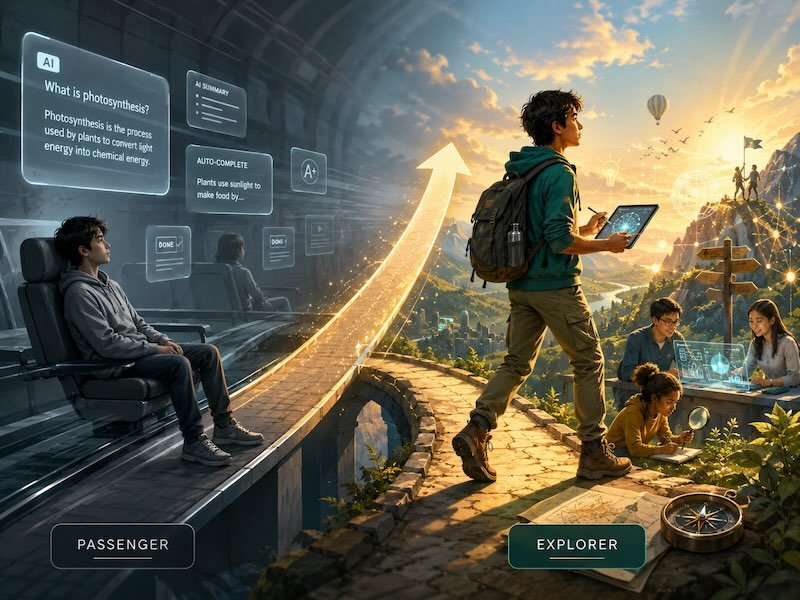
Unregulated AI can push students into what might be called passenger mode. In passenger mode, students receive content, accept the answer and move on. They may appear productive, but they are not fully engaged in the thinking process.
The aim should be to help students become explorers. Explorers use AI to test ideas, compare explanations, receive feedback and extend their thinking. They remain active. They ask questions, make choices, evaluate responses and improve their own work.
This distinction matters because AI changes motivation. If a task can be completed instantly by a tool, students need a stronger reason to engage with the learning process. Teachers therefore need to design lessons where the value is not just in the final answer, but in the thinking, discussion, drafting, reflection and explanation that lead to it.
Assessment also needs to respond to this shift. If teachers only assess the final product, AI makes it harder to know what a student actually understands. Schools should place greater emphasis on evidence of learning. This can include drafts, version history, oral explanation, live demonstration, reflection and teacher questioning. The process matters as much as the product.
The opportunity: the AI teaching dividend
Although the risks are real, AI also offers a significant opportunity. Used responsibly, AI can save teachers time on routine tasks such as lesson planning, translation, resource adaptation, administrative writing and assessment design. This saved time should not simply be absorbed by more work. It should be reinvested into the human aspects of teaching.
The real AI teaching dividend is not automation for its own sake. It is the chance to spend more time on progress monitoring, individual feedback, relationship building and targeted intervention. These are the areas where teachers make the greatest difference.
AI can also support inclusion. It can help adapt reading levels, provide alternative explanations, generate examples, support language learners and offer additional practice. For neurodivergent students or students who need more personalised scaffolding, AI can help teachers respond more flexibly.
However, personalisation must not become isolation. Students still need shared experiences, discussion, challenge and teacher guidance. AI should support the classroom community, not replace it.
Purpose before tools
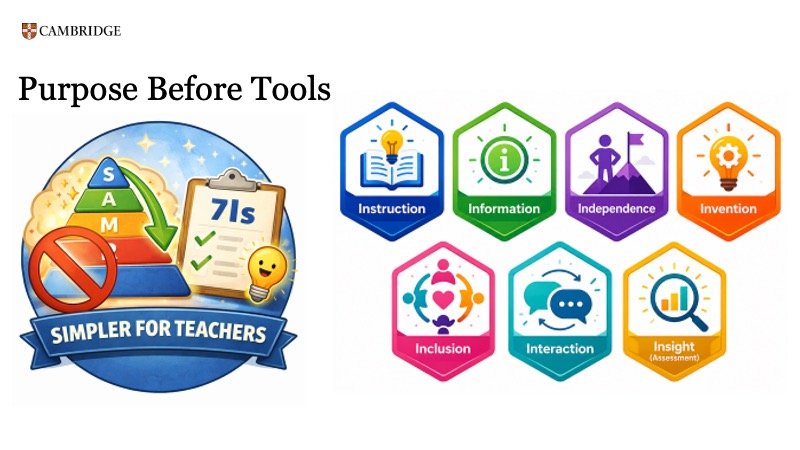
Schools need to begin with purpose, not technology. The question should not be, “How can we use AI?” The better question is, “What learning purpose are we trying to achieve, and can AI help us do it better?”
A useful way to think about this is through key teaching purposes: instruction, information, independence, invention, inclusion, interaction and insight.
Instruction is about how clearly teachers explain and model new knowledge. AI can help generate examples, analogies or alternative explanations, but the teacher still decides what is accurate and appropriate.
Information is about the quality and accessibility of resources. AI can help transform material into different formats, but teachers need to check accuracy and suitability.
Independence is about students taking ownership of learning. AI can support self-paced work, but it should not remove the need for effort.
Invention is about students creating original work, solving problems and designing new outcomes. AI can support brainstorming and prototyping, but students still need to make decisions and refine their work.
Inclusion is about helping all students access the curriculum. AI can provide scaffolds, translations and alternative explanations, but it must be used carefully and ethically.
Interaction is about dialogue, collaboration, questioning and feedback. AI should not reduce classroom talk. It should create more opportunities for meaningful interaction.
Insight is about assessment and checking for understanding. AI can help analyse patterns and generate questions, but teachers need to interpret what the evidence means.
This approach keeps pedagogy at the centre. Technology should serve learning, not lead it.
The importance of balance
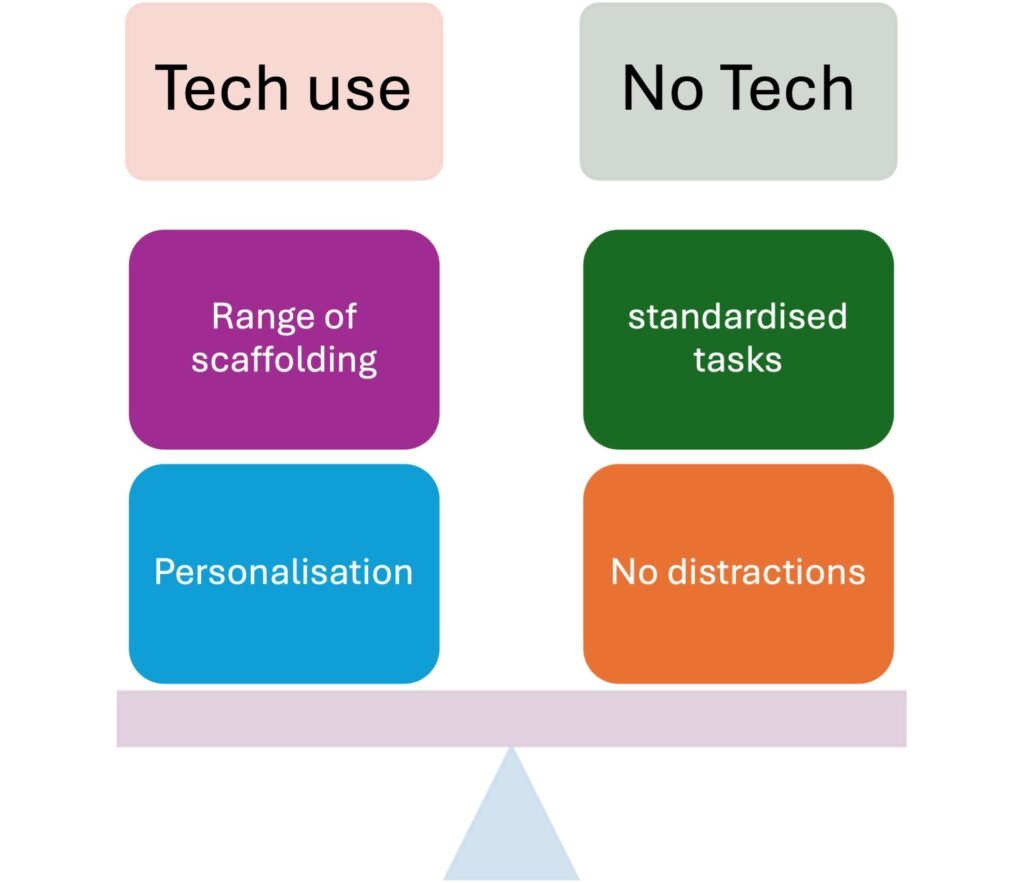
Observations across lessons suggest that effective technology use is often selective rather than constant. Teachers make deliberate decisions about when devices add value and when they may distract from focused learning. In some lessons, technology supports research, personalised scaffolding or formative assessment. In other lessons, no technology is the better choice because students need concentration, handwriting, discussion or extended reading.
This balance is important. A good lesson does not need to be full of technology to be modern. Equally, avoiding technology completely does not prepare students for the world they live in. The aim is thoughtful use.
Handwriting and typing also serve different purposes. Handwriting can support active learning, memory and early concept formation. Typing can support productivity, editing, drafting and longer outputs. Students need both. The decision should depend on the learning goal.
Prosper, prepare and protect
A practical framework for AI in education can be built around three actions: prosper, prepare and protect.
To prosper, schools should use AI in ways that enrich learning. This means targeted augmentation rather than full automation. AI should complement and strengthen human knowledge, skills and judgement. It should help teachers design better learning and help students think more deeply.
To prepare, schools need to develop AI literacy across the whole ecosystem. Educators, students, families and systems all need a shared understanding of what AI can do, what it cannot do and how it should be used ethically. This includes prompt writing, critical evaluation, data privacy, bias, misinformation and responsible use.
To protect, schools must defend students from harmful design features and commercial pressures. Many AI tools are built for adult productivity and maximum engagement, not child development. Schools need clear safeguards around privacy, safety, emotional dependency, anthropomorphism and over-reliance. Families also need guidance so that healthy habits are reinforced beyond school.
Vibe coding and creative momentum
One area where AI can be especially powerful is digital creation. Vibe coding changes the way people approach building software. Instead of starting with a blank screen and needing advanced technical knowledge, users can move quickly from idea to prototype through prompts, feedback and iteration.
For teachers, this opens up new possibilities. They can create interactive resources, classroom tools, quizzes, simulations and prototypes more quickly. For students, it lowers the barrier to entry and can make computing feel more creative and accessible.
However, vibe coding should still be treated as learning. Students need to understand what the code does, test it carefully, debug problems and improve the design. The goal is not just to generate something that works. The goal is to use AI to accelerate creativity while still developing understanding.
Vibe coding treats digital creation more like sketching than traditional engineering. You build first, observe what works and then improve. This can create momentum, especially for learners who might otherwise feel blocked at the beginning.
Key questions for teachers
AI will not remove the need for teachers. It makes the teacher’s role more important. Teachers are needed to build foundational knowledge, create trust, design meaningful learning experiences and protect students from shallow or harmful uses of technology.
Several questions can guide classroom practice:
- Are students building the foundations of knowledge before they use AI to extend their thinking?
- How is personalisation being used without isolating students from challenge and discussion?
- How can difficult concepts be made easier to visualise, question and interact with?
- How can students be encouraged to act as explorers rather than passengers?
- How will teachers assess the learning process, not just the final product?
Conclusion
Teaching has changed because the world around students has changed. AI is here to stay, and schools need to respond with clarity rather than panic. The future of AI in education will not be determined by the technology alone. It will be determined by the choices teachers, leaders, families and students make together.
The strongest approach is not blind adoption or total rejection. It is deliberate, human-centred design. AI should amplify teaching, not replace it. It should strengthen knowledge, not bypass it. It should support creativity, inclusion and insight while protecting the developing brain.
The technology can scale, but pedagogy must ground it. If schools keep learning, relationships and human judgement at the centre, AI can become a tool for enriched learning rather than diminished learning.
References
Abela, J. (2026). Vibe coding: From idea to app at the speed of flow [Kindle edition]. Amazon. https://www.amazon.com/Vibe-Coding-Idea-Speed-Flow-ebook/dp/B0GNZSC39P
Burns, M., Winthrop, R., Luther, N., Venetis, E., & Karim, R. (2026, January 14). A new direction for students in an AI world: Prosper, prepare, protect. Brookings. https://www.brookings.edu/articles/a-new-direction-for-students-in-an-ai-world-prosper-prepare-protect/
Kokotajlo, D., Alexander, S., Larsen, T., Lifland, E., & Dean, R. (2025, April 3). AI 2027. https://ai-2027.com/
New South Wales Department of Education. (2025). Student response systems: Explicit teaching strategy – checking for understanding: Technique guide. https://education.nsw.gov.au/content/dam/main-education/documents/teaching-and-learning/curriculum/explicit-teaching/explicit-teaching-student-response-systems-technique-guide.pdf
Van der Weel, F. R., & Van der Meer, A. L. H. (2024). Handwriting but not typewriting leads to widespread brain connectivity: A high-density EEG study with implications for the classroom. Frontiers in Psychology, 14, Article 1219945. https://doi.org/10.3389/fpsyg.2023.1219945
