
Bett Asia returned to Kuala Lumpur on 23-24 September 2026, bringing together educators, policymakers, school leaders and technology companies from across the region. Artificial intelligence was inevitably everywhere, but after working through the sessions, taking part in the TeachMeet and delivering my own workshop on Vibe Coding, I came away feeling that balance has been restored to the force or at least restored to the AI force!
The big question at Bett Asia is, what we should actually do with those capabilities in education? Again and again, speakers returned to learning, attention, assessment, teacher expertise and human judgement. The technology may be changing extraordinarily quickly, but some of the questions being asked were reassuringly old ones: Are students thinking? Are they learning? Are we making good use of teachers’ time? Are our assessments measuring understanding? Is the technology helping us solve an educational problem, or have we simply found another shiny tool?
Some difficulty is productive
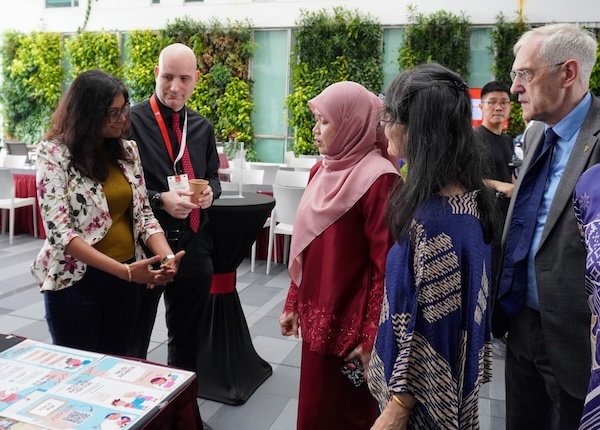
One of the strongest comments of the conference came from Malaysia’s Minister of Education, Datuk Seri Fadhlina Sidek, who warned about the danger of students becoming “hasty readers” as AI makes it increasingly easy to summarise and simplify information. Her argument was not that AI should be removed from education, but that efficiency can sometimes remove something important from the learning process.
“There is value in having to think. Some difficulty is productive.”
That line captures a challenge that schools are going to have to wrestle with. Education has spent decades trying to remove unnecessary barriers to learning, and rightly so, but not every difficulty is an unnecessary barrier. Reading a challenging paragraph, attempting a problem before seeing the solution, struggling to express an argument or debugging a piece of code all require cognitive effort. Sometimes that effort is precisely where the learning happens.
This theme appeared elsewhere in discussions about assessment. Generative AI has made it increasingly difficult to place complete confidence in a polished final product as evidence of learning. A beautifully written essay, presentation or piece of code no longer tells us as much as it once did about the thinking that produced it. Bett’s session on authentic assessment argued that the challenge is therefore moving away from trying to police every possible use of AI and towards designing assessments that make students’ reasoning, decisions and understanding more visible.
Shoaib Raza, Director of Digital Learning and Entrepreneurship at Nexus International School Singapore, joined neuroscientist Dr Damla Khan for Beyond Screen Time: Digital Maturity, AI and Human Attention. Their argument was that the traditional debate about how many minutes young people spend on screens is becoming far too simplistic. As digital environments become increasingly personalised, persuasive and AI-driven, schools need to think instead about how technology shapes attention, behaviour, decision-making and learning. The session introduced the idea of digital maturity – helping students use technology intentionally rather than simply reacting to notifications, recommendations and algorithmic prompts. This moves the conversation beyond restricting devices towards developing human judgement, agency and cognitive resilience, asking not simply how much technology students use, but whether they are able to recognise when it is helping them, distracting them or beginning to make decisions on their behalf.
That might mean asking students to defend a piece of work orally, explain the choices they made, show drafts, reflect on how their thinking changed or apply their understanding to a new problem. At the TeachMeet, Showing Understanding explored exactly this idea. Rather than trying to determine whether a polished poster or research paper had been produced with AI, students were asked to present and defend their work. The important evidence was not simply the finished artefact, but whether the student could explain it.
For me, this is one of the most important changes AI is forcing us to confront. The answer cannot simply be better AI detection. We need better evidence of learning.
Beyond screen time
Another session that stood out was Beyond Screen Time: Digital Maturity, AI and Human Attention. The central argument was that simply counting minutes on a device tells us very little about what a learner is actually doing. An hour spent programming, designing, researching or collaborating is not cognitively equivalent to an hour spent passively scrolling through algorithmically selected content.
The session introduced the idea of digital maturity: helping young people develop the judgement to decide when, why and how technology should be used. It also explored how notifications, persuasive design and constant task switching can influence attention and behaviour. The aim is not therefore to produce students who can merely operate technology, but young people who can make intentional decisions about their relationship with it.
This connects closely with another Bett theme: moving from digital literacy to digital agency. Access to powerful AI systems is becoming increasingly widespread, but equal access does not necessarily produce equal outcomes. One learner might accept the first answer an AI produces, while another questions it, checks it, alters it and ultimately decides to reject it. The differentiator becomes not access to the machine, but the judgement of the human using it.
That is a much more interesting definition of AI literacy than simply teaching students how to prompt.
The TeachMeet brought the conversation back to the classroom
The Bett Asia TeachMeet was one of my favourite parts of the event and not just because I run them! It brings these large questions down to classroom level. Instead of discussing transformation at the level of national strategies or technology platforms, practising teachers had a few minutes to share something they were actually trying.
There was plenty of AI, but very little AI for its own sake. Ian Pittman’s Stop AI Slop looked at the difference between accepting the first generated image and treating AI generation as an iterative design process. Beyond the AI Wow Factor summarised its philosophy neatly as “Human first, AI supports, Human decides”. The technology could help organise ideas, critique questions or expand possibilities, but it did not replace the context and judgement supplied by the teacher and learner.
Other presentations barely needed AI at all. James Shirlin from Garden International School explored an AI-assisted flipped classroom in which students prepare Cornell notes before lessons and use AI to question their understanding, allowing classroom time to focus much more heavily on questioning, mini-whiteboards, application and teacher evaluation. Valerie Quaye from The Alice Smith School showed how technology could help “close the loop” on feedback by giving students a structured opportunity to reflect on and act upon comments rather than simply receiving them.
Some of the strongest TeachMeet sessions focused on multilingualism. Presenters explored multilingual classroom libraries, academic vocabulary, reporting and the importance of separating a student’s proficiency in English from their underlying cognitive ability. The common thread was that technology and classroom systems should allow more students to participate meaningfully rather than asking every learner to fit the same narrow model.
There was also a useful reminder that innovation does not automatically mean AI. Srdan Ilic’s One Artwork, Many Artists showed students collaborating on arcade games, cave art, map puzzles and murals. Students had to negotiate, create, solve problems and develop a shared sense of ownership. These might not attract the same headlines as generative AI, but they are exactly the kinds of experiences that remain valuable in an AI-rich world.
From asking AI questions to building things with it
My own contribution to Bett Asia was a workshop called Vibe coding: Using AI to code for you. The idea behind the session was that generative AI is beginning to change who gets to build software.
At Bett I demonstrated examples including a Shape Garden Builder for younger learners recognising 2D shapes, a Kinematics Motion Lab using dynamic graphs, a Blackout Poetry Creator and an Algebra Balance Lab. The point was not that every teacher should suddenly become a software engineer. It was that the distance between “I wish I had a resource that did this” and “I have built something that does this” has dramatically reduced. Bett described the workshop as a repeatable process for turning ideas into practical classroom tools in hours rather than weeks.
This is where I think the conversation about AI becomes much more exciting. There is a significant difference between asking an AI to generate another worksheet and using it to create something that previously would not have existed. Teachers understand their students, curriculum and classroom context incredibly well. Giving those teachers the ability to prototype their own software means that educational technology can increasingly begin with a real classroom problem rather than a product catalogue.
There are important limitations. Vibe coding does not make technical understanding irrelevant, particularly as projects become more complicated. There is still a point at which knowledge of programming, data, privacy, testing and security matters enormously. We should not mistake lowering the barrier to entry for eliminating the expertise required to build robust software. However, as a method for prototyping ideas and creating focused classroom resources, the possibilities are remarkable.
I also demonstrated this idea during a Google Malaysia Demo Slam at Bett Asia by using Gemini to create an interactive simulation of the states of water in under five minutes and then publishing the finished resource through Google Sites.
The interesting change is that a teacher can have an idea during lesson planning, create a working version, try it with students, see what actually happens and then improve it. The development cycle becomes part of normal professional practice rather than a separate software project.
Teachers need support, not another list of tools
Teachers are being presented with an extraordinary number of platforms, AI systems and new capabilities, often accompanied by pressure to adopt them quickly. The EdTech Overload panel argued for professional development based on simplicity, relevance and sustained support rather than isolated training days. Teachers need opportunities to experiment, share practice, make mistakes and receive help when they actually encounter problems.
An AI strategy should not simply consist of buying licences and delivering a workshop showing staff where the buttons are. Schools need to decide what problems they are trying to solve, what good teaching looks like in their context, what safeguards are necessary and how they will know whether a change has actually improved learning.
Perhaps the AI wow factor is wearing off
For an EdTech conference in 2026, Bett Asia was surprisingly human. AI was everywhere, but many of the strongest conversations were about the things AI should not replace: thinking carefully, paying attention, explaining an idea, making a judgement, receiving useful feedback, collaborating with other people and creating something that matters.
That is why I think the gradual disappearance of the AI “wow factor” is healthy. We need to get past the point where generating an image, producing a paragraph or creating a small application is impressive simply because a machine did it. The technology is becoming normal remarkably quickly. Our expectations should rise with it.
The more useful question is what becomes possible when educators have these capabilities available to them. Can we create better learning experiences? Can we give students more meaningful problems? Can we make their thinking more visible? Can teachers build tools specifically for the learners sitting in front of them? Can technology create more time for explanation, feedback, creativity and human interaction rather than less?
Bett Asia 2026 did not provide one neat answer to those questions, but across the conference, TeachMeet and hands-on workshops, there was a remarkably consistent direction of travel.
AI used well can support, but humans still need to decide what we should be learning and why.
